Carbon Ion RadioTherapy (CIRT) is an efficient means of cancer therapies because the Carbon ion beam can be accurately concentrated on the planning target volume (PTV) and it also has a high biological effect.
Here in Japan, since the completion of HIMAC (Heavy Ion Medica Accelerator in Chiba) of NIRS (now QST) in 1994, the CIRT treatment has been done to a large number of patients.
Based on the results of the treatments, retrospective study is being done to improve the safety and effectiveness of the CIRT therapy.
Carbon-12 beam used in CIRT is often characterized by dose-averaged LET (LETd, where LET stands for Linear Energy Transfer).
Matsumot et al. reported that no recurrence has been observed in the cases where LETd in PTV is larger than 40 keV/μm in the CIRT treatment.
Although the usefulness of LETd as a characteristic of biological effect is widely recognized from the results obtained in the retrospective study, it cannot be directly calculated, and therefore cannot be used in advance for a patient's treatment planning; formerly, LETd distribution was estimated from those of physical and clinical doses.
It is, however, well known that the accuracy of the estimated LETd obtained with the conventional methods will be degraded at high-LET regime (>100 keV/μm) due to the overkill effect, and the results deviate further from those based on the physical dose.
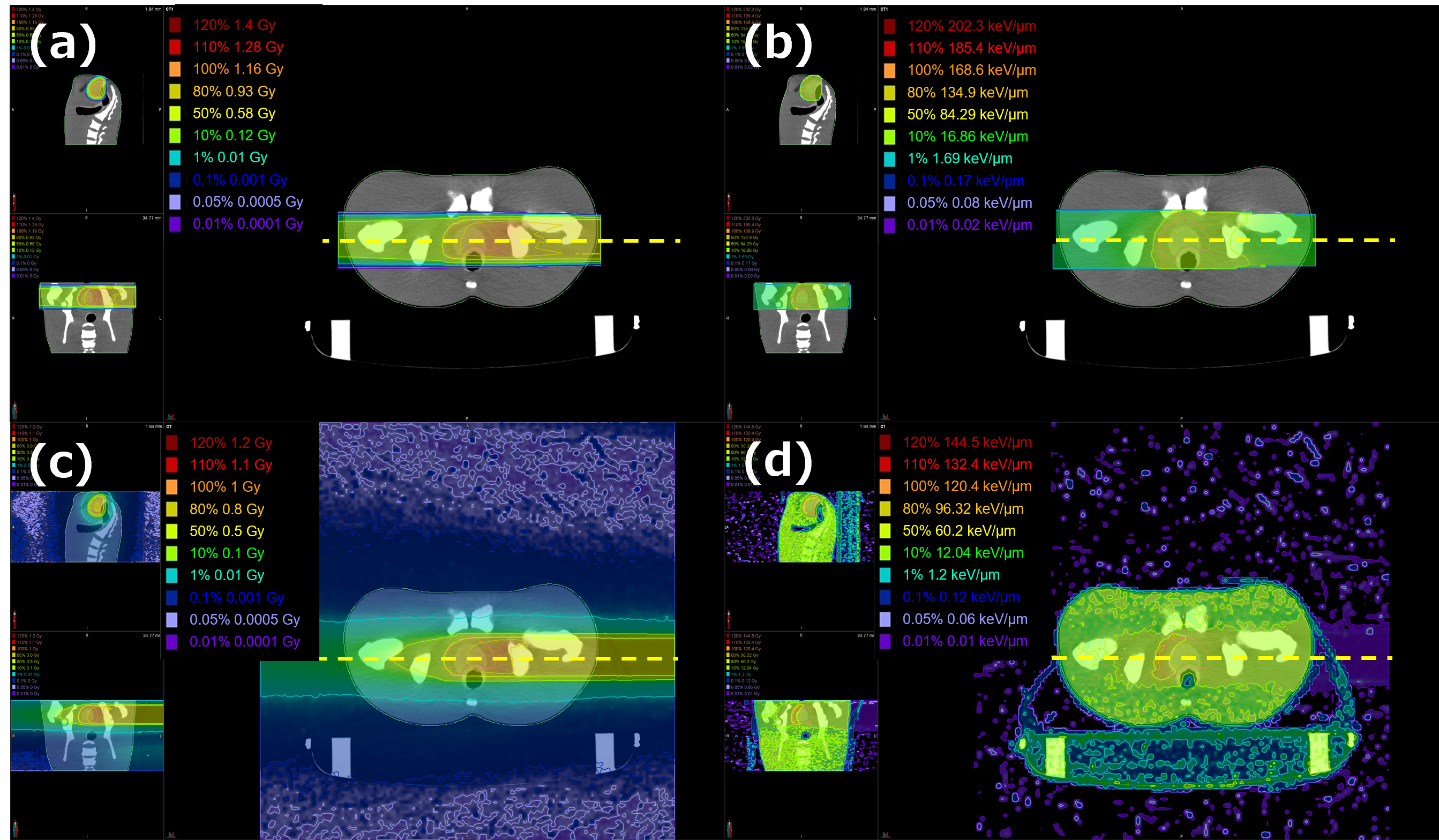
Therefore, we have calculated the LETd distribution for a CIRT treatment plan on a test phantom, by utilizing a module named "RT-PHITS for CIRT" implemented in a radiation transport code system "PHITS". The obtained resuls were then compared to the estimation by the conventional methods, and check the validity and limitation of the retrospective study.
The comparison shows that, although the conventional method underestimates LETd at around the region where 12C particles are almost stopping, in other areas the estimated values agree very well with those obtained using the PHITS module, indicating that the numerous findings obtained through the retrospective study remain still valid in which the minimum LETd in the PTV were estimated based solely on the conventional method.
At the same time, it is shown that, in the research in which precise estimation of radiation dose outside the PTV is required due to the predominance of the contribution from secondary particles there, it is desirable to do retroactive dose evaluation with RT-PHITS for CIRT for the treatments already done, based on the treatment plans actually used.
We are going to do the retroactive estimation, and try to find the reason that CIRT treatment causes lower secondary cancer risks compared to the one with X-ray.