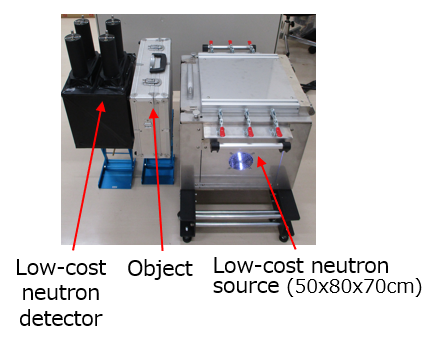
As the risk of nuclear terrorism is continuously rising worldwide, it is of increasing importance to detect and prevent smuggling of nuclear materials at the borders such as airports and harbor facilities. But conventional active-neutron NDA devices are usually bulky and expensive and not maneuverable, making them unsuitable for the smuggling detection. In order to fill the need for portable and low-cost nuclear detection devices, we have developed "NuS-RIM" (Fig. 1).
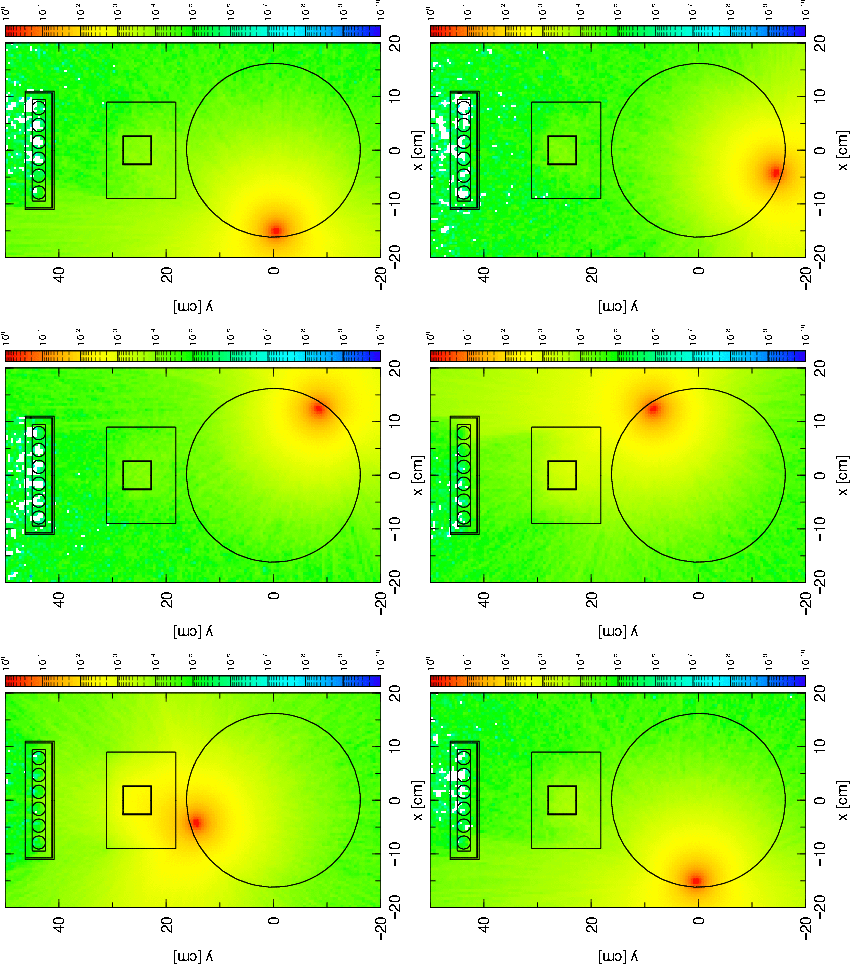
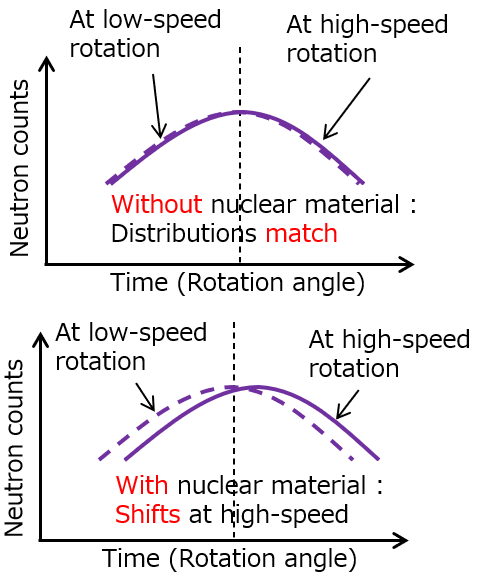
By utilizing a high-frequency circular movement of a neutron source (252Cf), this device can detect the presence of nuclear materials without dissolving the things of interest. Further, by scrutinizing the differences in the time of fission-neutron detection, we found that the neutron time spectrum is shifted only in the presence of nuclear materials and at high circular movement of the neutron source. Based on this, we established a method of high-sensitivity nuclear material detection.
A proof-of-principle measurement using a prototype of such a portable device, which costs as low as one-tenth of the conventional ones and achieved considerable down-sizing, and without any legal requirements to obtain RI permissions, demonstrated that the device can detect as small as 57 grams of 235U. This method is expected to have a contribution in the nuclear security and to become an effective means of nuclear-terror prevention at transportation hubs as well as large-scale events where many participants gather.
The table below compares several aspects of nuclear detection devices based on our newly developed detection method to conventional ones.
| Conventional (FNDI method) | Low-cost portable nuclear detector (NuS-RIM) | |
| Cost | > 70M(JPY) | ~6M(JPY)(~ X-ray baggage inspection devices) |
| Size | Large (non-portable) | Small (portable) |
| RI permission | required | not required (certified RI equipment w/ label) |
| radiation exposure | Evacuation in need | No need to evacuate |