It is one of the important but difficult issues in the decommissioning of Fukushima-Daiichi nuclear power plant to accurately quantify the amounts of nuclear materials contained in nuclear debris and other retrieved materials taken from the vessels, because it affects the design of their storage as well as the method of their managements. There are many types of collected items, from debris which may contain many fragments of nuclear fuels, to structure materials to which a minute amount of nuclear material is adhered. The sorting of such items according to the amount of stuck nuclear materials can greatly contribute to the streamlining of decommissioning.
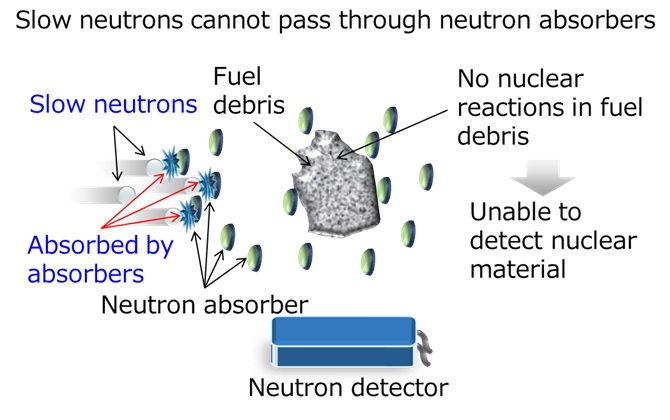
For the measurements of the amount of nuclear materials accompanied with such items, so-called active neutron method is thought to be effectively applicable. In the method, the sample is irradiated with interrogation neutrons to induce nuclear fission in nuclear materials, and the neutrons emitted in the fission reaction are counted to deduce the amount of nuclear materials. But the nuclear debris might contain neutron-absorbing materials originated from the control rods of the nuclear reactor, and the fact makes the application of simple active neutron method difficult to the measurement of nuclear materials in the fuel debris (Fig. 1).
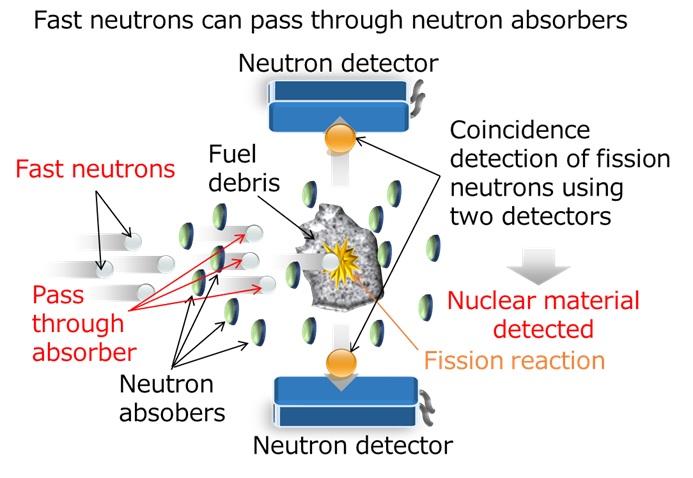
To overcome this difficulty, we note the fact that fast neutrons are not largely absorbed by the neutron-absorbing materials but easily induce nuclear fission, and use the fact in our newly invented measurement method. In the method, several fast-response neutron detectors are used for the coincidence counting of multiple fast neutrons emitted in the induced fission in nuclear materials (Fig. 2). We performed a proof-of-principle experiment and demonstrated that the method can effectively isolate and count fission neutrons and that it can be applied to the non-destructive assay of nuclear materials accompanied by neutron-absorbing materials, which is thought to be difficult with the conventional active neutron methods. The method is based on the coincidence counting of fast-neutron induced fission neutrons, and we named the method "Fast Fission neutron Coincidence Counting (FFCC) method".
The application of this method is not limited to the non-destructive assay of nuclear materials in the fuel debris of Fukushima-Daiichi NPP accident; it can be thought applicable to the detection of hidden nuclear materials, which is an important issue in nuclear security. Now that the principle of the method has been proved, we will then move to the design and testing of the measurement devices considering the ease of on-site operation, and will try to realize its practical application as soon as possible.