Background
It is well known that lightning is a natural phenomenon accompanied by intense optical flashes, loud thunder, and radio waves. In addition, recent observations showed that lightning also produces radiation.
High-energy radiation with more than one million electron Volts (1 MeV) has been observed. Strong electric fields within lightning and thunderclouds are believed to act like medical X-ray generators, accelerating electrons to generate radiation. One of the curious things is that, whereas the electrons are accelerated in near-vacuum in a medical X-ray generator, the density of the atmosphere is considerably (more than 109 times) higher than the near-vacuum inside an X-ray generator and therefore it is extremely difficult to accelerate electrons to higher energies.
Winter-lightning monitoring along the coast of the Sea of Japan
To unravel this mystery, our group is conducting observations along the coast of the Sea of Japan in collaboration with the University of Tokyo, RIKEN, and Osaka University. This region is well known for its frequent winter lightning, making it an ideal location for studying radiation emitted by lightning and thunderclouds.
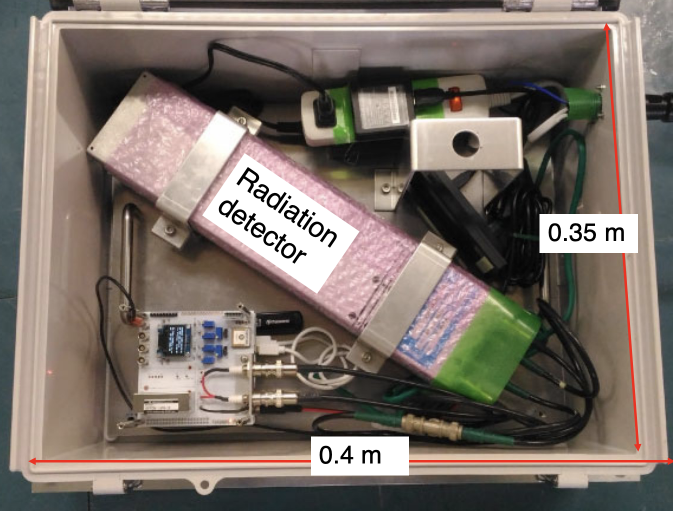
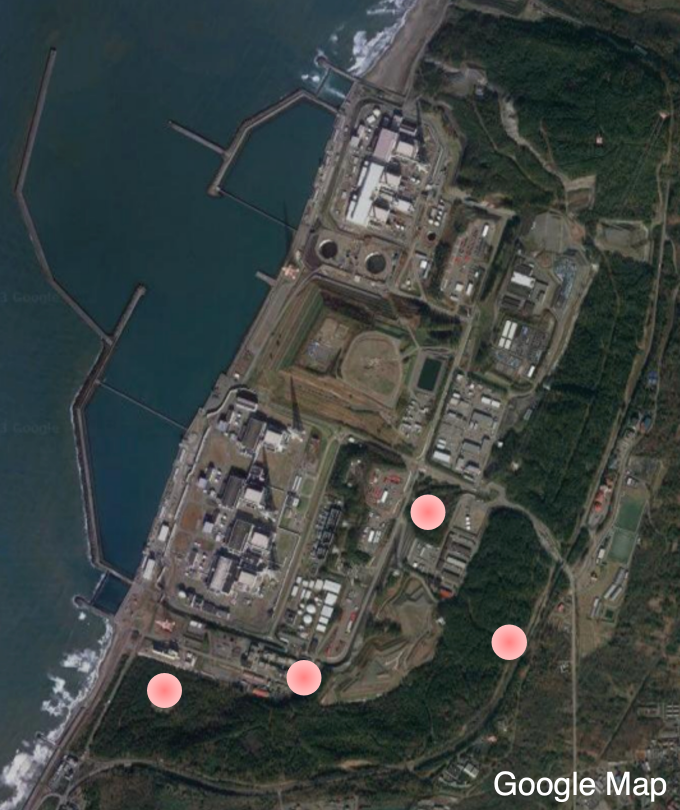
Although frequent, it is difficult to predict when and where the lightning occurs. Therefore, radiation measurement needs devices that can operate unattended and continuously over long periods. For this, we have developed a radiation monitoring system (Fig. 1) which enables the unmanned monitoring in the severe condition of winter Sea of Japan area, by utilizing a type of business card-sized PC (Raspberry Pi), and then started continuous monitoring of the radiation associated with lightning and thunderclouds using a set of the developed device at one of our monitoring sites, Kashiwazaki-Kariwa Nuclear Power Plant of TEPCO, in 2016 (Fig. 2).
Discovery of photonuclear reactions in lightning
In February 2017, lightning occurred at about one kilometer from the devices, and radiation was observed. Through the analyses of the obtained data, it was found that the energy spectra of the radiation had unique shapes, and that the intensity of radiation increased around several tens of seconds after the occurrence of the lightning.
Further detailed analyses, including a series of radiation-transport simulation, showed that these phenomena can be described as follows:
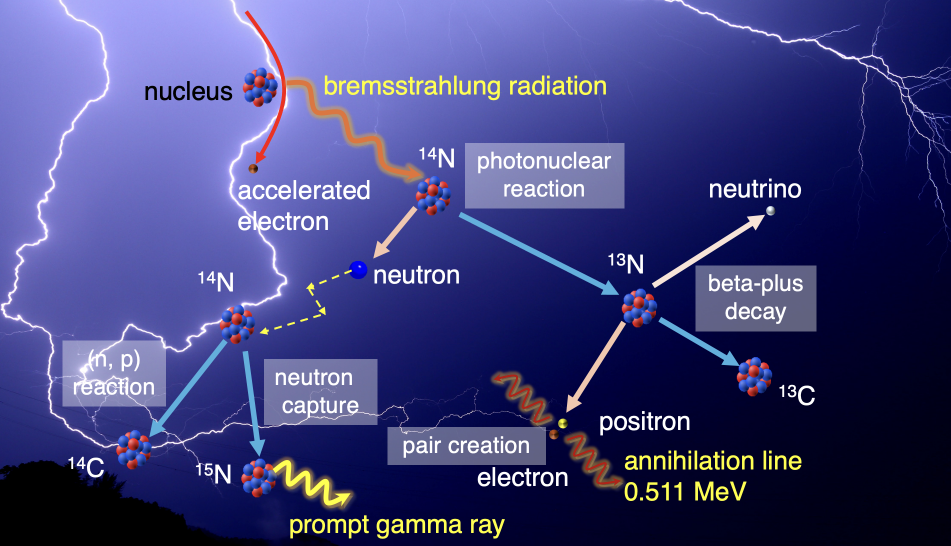
- Electrons are accelerated through the electric fields in the lightning, and then collide with atomic nuclei in the atmosphere, producing bremsstrahlung gamma rays.
- The bremsstrahlung gamma rays then interact with nuclei in the atmosphere such as Nitrogen-14 and Oxygen-16 and induce photo-nuclear reactions.
- Through the photo-nuclear reactions, neutrons are emitted. These neutrons are transported and moderated through the atmosphere, and finally captured by nuclei such as Nitrogen and Oxygen. Prompt gamma rays are emitted in the capture process.
- In the photo-nuclear reaction of Nitrogen-14, one of its radioactive isotopes, Nitrogen-13, is produced, which then β+-decays with a half-life of about 10 minutes and emits a positron (the anti-particle of the electron).
- Positrons annihilate by colliding with electrons in the atmosphere, producing a pair of 0.51-MeV gamma rays.
Our devices observed the prompt gamma rays originated from Nitrogen nuclei as well as annihilation photons (0.51 MeV). The unique gamma-ray energy spectra are due to the prompt gamma rays, whereas delayed increase in intensity is caused by the annihilation photons. This study shows for the first time that nuclear reactions do occur in lightning and reveals its new aspect.